




















Downtown Omaha and its surrounding environs have always been a place that I love to visit when I have the time. From watching baseball games at the Chuck during the College World Series in June to shopping at Homer’s and Hollywood Candy in the Old Market, Omaha has a lively charm that sets it apart from other midwestern cities like Des Moines and Sioux Falls.
But one thing that our city government is currently constructing to supposedly help our city “boost tourism” and help us become “world-class” will degrade the entire experience in Downtown Omaha:
The Streetcar Project.
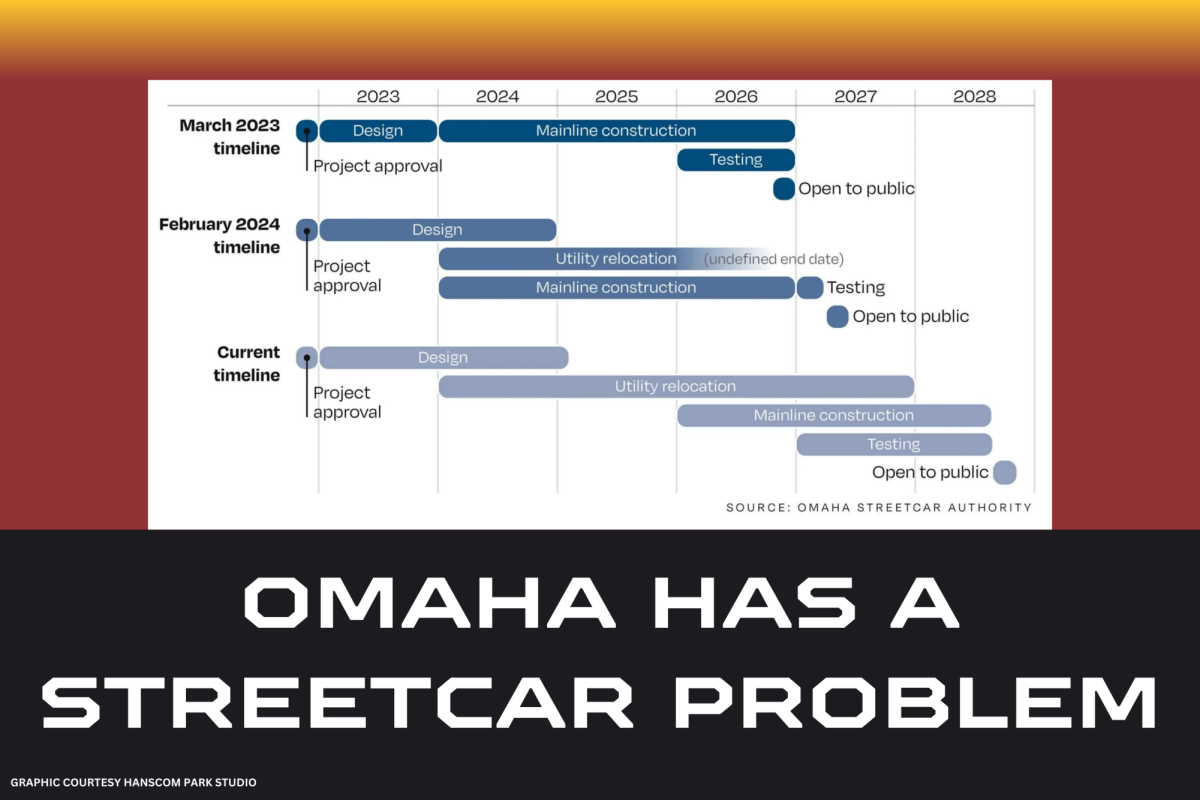
I must admit that I have never had a positive outlook on the project, even when it was announced in 2022. However, as time has passed and it appears to be stagnating further, my opinion has deteriorated to a point where I believe the entire project is an unnecessary vanity that will never see full use by the people of our city.
The financial runaway train that has plagued this project is where I’ll start: In late February, the Omaha City Council discussed a $70 million lease revenue bond issue for the streetcar project, on top of the $440 million approved in 2022.
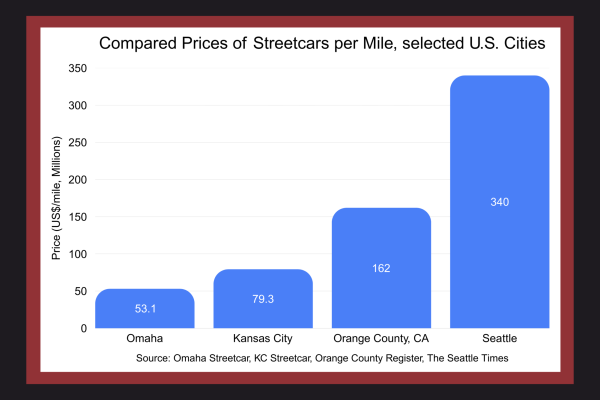
Unlike typical revenue bonds, which are supported by consumer-based investments like trip fares, these are backed by the city government––and if the supposed urban development along the route doesn’t generate enough tax money, taxpayers could be on the hook.
Although potential development would provide advantages for a growing Omaha, the inflexibility of a streetcar, confined by rail and wire, presents a costly decision for a city that operates on a non-east-to-west basis.
Streetcars can only mindlessly go back and forth on the same track with no possibility for future change without further ripping up of roads, contrary to bus systems and even ORBT, which can add, subtract, and change the route of lines when necessary and in a short amount of time.
This creates a major question regarding the lack of adaptability: Is making one corridor for what is essentially a vanity project worth it?
As construction on the streetcar progresses, the project is being represented more as a fight for survival rather than an opportunity for companies and individuals to create and grow their businesses.
According to the Flatwater Free Press, several businesses in the Blackstone District have already closed their doors or have been forced to move due to the length of utility and road work. Even when the streetcar is said and done, the impact of a lengthy construction progress has already created a bruise that has discouraged me from going to Downtown for the time being.
Justin Wayne, a Nebraska state senator at the time of the beginning of the streetcar project, stated in January 2022 that the manufactured blighting of districts in downtown like the Blackstone is a “slap in the face to North and South Omaha,” citing them as areas that would benefit more from development than the already-bustling downtown.
The closure of major roads such as Farnam and Harney Streets due to streetcar construction has also resulted in bottlenecking in the area. The permanent removal of traffic lanes on these arteries to accommodate tracks could lead to long-term congestion in the urban core, which is detrimental to a city that primarily relies on cars for transportation.
While the progress made on the streetcar is irreversible without a substantial investment to dismantle it all, there are still opportunities to enhance the overall public transportation system in Omaha.
For an example, expanding Metro bus lines west to suburbs like Elkhorn and Millard would greatly benefit people in those areas who may not have reliable access to cars for transportation.
When I visited Switzerland in the summer of 2024, public transportation can drastically increase the speed of moving around places in society. Urban cantons perform an excellent job of providing intra-city rail connections, while the Swiss Federal Railways and other regional companies provide connections to almost every municipality in the country.
Having even a light-rail line between East and West Omaha would be greatly beneficial, and would offer more utility than a three-mile strip of track for something that can only go about twenty miles per hour. If the city of Omaha was truly set on providing opportunity for growth and development, having a light-rail will provide a much larger prospect to help expand the urban core.
In a letter to the Omaha World-Herald dated January 2026, Warren Buffett remarked, “Mistakes are literally cast in cement,” emphasizing that poor decisions like the Omaha Streetcar can leave long-lasting consequences that cannot be easily reversed And as the city progresses farther on the project, the Oracle of Omaha’s words are being set in stone as the truth: The Streetcar in its current state is severelydetrimental to our urban core, and its effects will linger on downtown for as long as it exists.