












For many years, universities and their sports programs have been held accountable for tampering with recruits. Wins are vacated. Recruits are lost. Players, coaches, and universities are punished for rule violations.
In some instances, the players get punished even more than the coaches. For example, Reggie Bush had to forfeit his 2005 Heisman Award due to NCAA violations.
Since 2021, Name, Image, Likeness, or NIL has been in place, and this has complicated recruiting dramatically. With NIL, coaches and boosters can poach players from other schools and offer them lucrative deals that can amount to even more than some might earn in the NFL.
These players getting lured away have led to many accusations of tampering, which is illegally recruiting and contacting players. Ole Miss has been painted as the face of this conflict, as multiple cases have surfaced of the Rebels tampering with other schools’ players. For example, texts with Fresno State wide receiver Josiah Freeman were against NCAA protocol.
With NIL, the NCAA has already found 95 cases of tampering this year. Coaches have voiced their disapproval over tampering but have now accepted it as a part of the evolving game. With so many changes in recent years, coaches who haven’taccepted this reality will eventually be left behind.
Clemson’s Dabo Swinney is one name often mentioned as hesitant in the Transfer Portal, but in the past two years he has been a bit more aggressive with NIL and the new rules. This season, he has had a bad experience with these new rules and strategies.
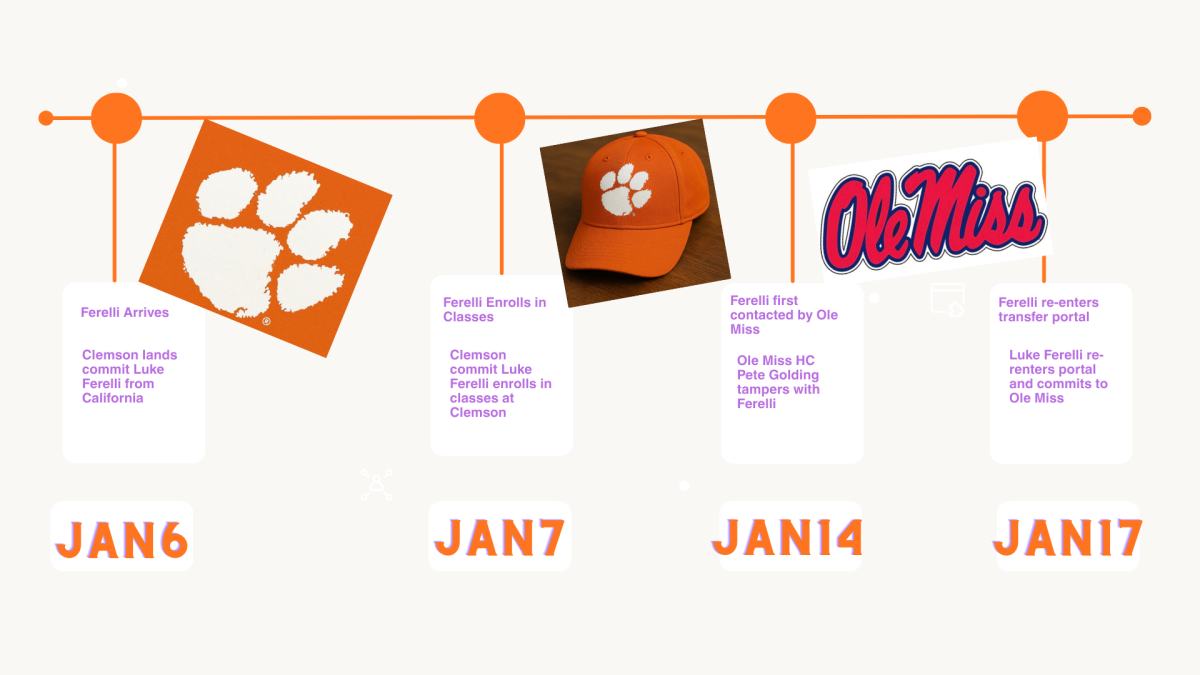
Clemson got former All-ACC mention and ACC Rookie of the Year, Luke Ferelli, from the University of California in the transfer portal. Following this, Ferelli enrolled in classes, rented an apartment, and even started attending preseason team workouts. This is when Ole Miss Head Coach Pete Golding started contacting him.
Ferelli, while attending classes at Clemson, was heavily recruited by Ole Miss staff and alumni. Clemson Head Coach Swinney was informed by Ferelli’s agent and was offered receipts of the text messages in exchange for a $1 million extension on Ferelli’s NIL contract. Swinney declined, which led to Ferelli entering back into the transfer portal and heading to Ole Miss.
Swinney sounded off on Ole Miss and its staff, calling them a “hypocrisy” and accusing them of “blatant” tampering. In a press conference, Swinney went on a rant about the current state of the transfer portal, saying “We have a broken system, and if there are no rules or consequences for tampering, then we have no rules and we have no governance.”
The University of Clemson and some other schools have come out with complaints about Ole Miss, and the NCAA is now taking all accounts into consideration in a full-scale investigation.
Swinney has gained support from coaches and analysts in the college football community for his comments on the transfer portal, and most people agree that something needs to be done.
This incident has followed other controversies like Demond Williams Jr. at Washington, where he signed a contract and then decided to leave Washington, before being forced to return after a lawsuit was filed. Another player Darian Mensah, left Duke for conference rival Miami and is now facing a lawsuit from Duke.
Swinney finished the press conference with an important reminder to fans everywhere, saying “This is not about a linebacker at Clemson. I don’t want anyone on our team that doesn’t want to be here. But it’s about the next kid and the next kid and the message that’s being sent with just blatant tampering being allowed to happen without consequences. This isn’t about our program. It’s about college football.”
Swinney’s message is simple, change needs to happen and rules needs to be enforced for the well-being of college football. As the new era of college football continues, these problems need to be solved before every coach and program in the country abuses the rules, giving the NCAA an even bigger mess to clean up.